XINYU LONG
In my research and reflection on art practice, I usually use short interrelated texts to document my critical thinking. These critical reflections help me to organize my creative thinking and extend it. This section will share my thoughts on ideologies, related artists, and drama. In addition to this, there will be some reflections on my personal experiences.
The thematic narratives and ideas in the previous unit were more abstract and a bit broader in scope compared to Unit 2, where the goal lines are becoming clearer and the work is slowly becoming more systematic.
Mothers raising children alone —— Sources for my research topic
My creative inspiration comes directly from my mother and grandmother. In fact, when I am asked to recall my family of origin, I don't get gloom and doom because most of the time it was happy and blissful, even though my parents were divorced as a child. My mother firmly took back custody of me on the occasion of the divorce, even though she was in a very modest financial situation at the time, and then she moved in with my grandmother. Since then, these two women have had a profound impact on my life, doing everything in their power to nurture and support what I wanted to perceive and be the most cohesive person in the family in a home environment where my father was failing in his duties. They were like a time machine, aligning work, family, and emotions without a single gap, and my mom told me that at one point in time, she was depressed because she couldn't find a place to pour out her heart, and all she could do was keep walking with her head buried in the sand. But whenever she mentions how much I've grown, she gets very accomplished again and just says that it was a slightly tougher road in life and that life is now full of promise. It reminds me of a line in Reply 1988 (2015) that says, "I heard God couldn't be everywhere, so he created moms."
Not long ago I learned in a video from an account(YITIAO) how large the group of mothers raising children alone is in Chinese society. I learned that there are presumably more than 20 million solo mothers in China, either divorced, widowed, unmarried, or possibly just in a marital crisis, with little father involvement in parenting. Among my friends, I learned that "fathers leaving home" is a common occurrence.
The following is a small talk (interview) I had with two friends:
Friend A: My dad hasn't cared about me since I was very young, he came home once in the middle of the day, but I remember I was very resistant to contact with him because I hadn't seen him in years. I didn't even like my dad's side of the family when I was a kid.
Me: So how is your relationship with your mom?
A: My relationship with her is more like a friend now, the kind where we can talk about anything.
Me: Are you going to improve your relationship with your dad in the future?
A: The chances are slim because he will continue to be almost absent from my life.
Me: Do you think your father was a big influence on your growing up?
Friend B: He was seldom involved in the major decisions of my life, my mom nagged me instead.
Me: Why?
B: My dad was a police and often on official business, I remember he was very busy every day.
Me: What about now, has the situation improved?
B: Now it's much more leisure than before, but he has used to skip contacting me, and every time I call I'm with my mom. For studying abroad it is also my mom who supports me, both monetarily and spiritually.
As explored by Yanhua Mao (1970) in her article, a humanistic perspective emphasizes the positive significance of ideal motherhood in empowering women, reshaping family culture, and reconstructing racial identity. I have also constructed such a theoretical background and new identity in my images, and this theme has provided me with a constant source of motivation and inspiration for my subsequent studio creations. And in the profound relationship between human mothers and Mother Earth, I have distilled something new.
My image conception journey
From abstraction to expression with figuration:
In fact, from the beginning of the navigation units, my images have begun to change, from the initial images of line elements arranged in combinations, to the present images of figurative images as the main body of the images and full of a sense of storytelling. On the one hand, I feel that images or paintings with a sense of narrative have a strong gripping power, which is different from the visual impact of purely abstract paintings, and this is what I have always wanted to pursue. On the other hand, I am influenced by the paintings of artist Sasha Gordon (1998) and Xingxin Hu (1988), my senior in the same course, their works let me find a new continent of practice.

My works at last unit
Sasha's works are related to misogyny, racism, and homophobia, and her characters are able to get rid of assumptions, and when naked, the skin and folds can show a lot of body language. In my subsequent work, I have delved deeper into the material I collect on a daily basis about the body, and I have found that this really brings out my themes of maternal skin and nature, as well as eliciting a greater response and communication from the viewer. As Hu said in the anticipation of her work, she wants to try to provoke a deep response from the viewers, inviting them to reflect on their own inner "desires and contradictions". (Hu, 2023)

Sasha Gordon, Garden Troll, 2021
Oil on canvas,141 x 79.4 x 3.8 cm

Xngxin Hu, Citrus Fruit, 2024
Oil on Canvas, 60 x 70 cm

Xingxin Hu, Synthetic Mind, 2023
Oil on Canva, 30 x 42 cm
Human and beast:
The original reason I wanted to combine the image of the woman and the beast is that I think they represent a primal and determined maternal force, a symbol of motherhood that can also be called a mother-beast. And because my images always contain some natural elements, in order to express the harmonious relationship between women and nature, I let the beasts from nature and the matriarchal society from primitive society merge, and I aim to achieve the dual senses of maternal power and natural power.
I then looked at some of the works created on this similar theme, For example, Florida's painting of The Wounded Deer (Florida Kahlo, 1946), in which she depicts herself as a young stag that has been shot with an arrow and is bleeding profusely. In the lower left corner, the artist has written the word "Carma", which means "fate" or "destiny". Like her other self-portraits, in this painting she expresses her sadness at not being able to change her fate. Including Picasso's Minotaur (Picasso, 1935), the same combination of human body and animal head is used to reflect the wildness and impulses of the human heart. The Minotaur is a symbol of violence as well as loneliness and struggle, revealing man's fear and fascination with the wild side of the self.


Frida Kahlo,The Wounded Deer, 1946
Pablo Picasso,The Wounded Deer, 1946
These works took me on an exploration of the relationship between man and beast, from fear and conflict to symbiosis and harmony. This is not just a visual impact, but also an exploring and reflecting on the deepest part of human's heart. Moreover, they also remind me of the concept of "bestiality", when humans look at animals from a bestial point of view, they describe them as having human characteristics, such as feelings, intelligence, social behaviors, etc. In religion and mythology, bestiality is also often used to express deities or supernatural beings, and I wanted to preserve this mystical power in my work, but from the human female rather than the animal. So I use human heads and some animal limbs as my graphic images.
My works in unit2

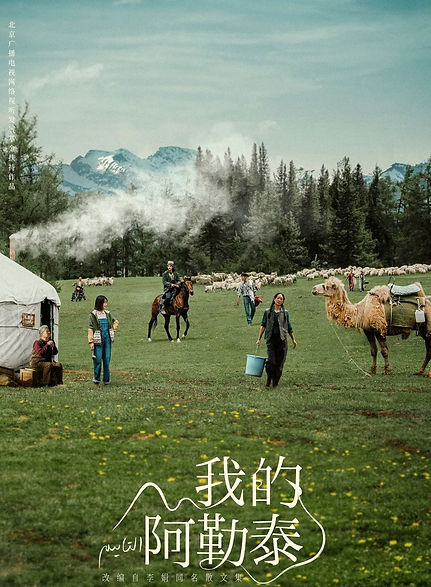
Great Wisdom in Human and Nature —— Drama:To the wonder(我的阿勒泰My Aletai )
This is a drama directed by Teng (1985) from the Chinese writer Li Juan (1979), adapted from her masterpiece of prose, My Aletai (Li, 2010), which is an original record of the author's life in the north of Xinjiang, including memories and insights of people and events. The whole book is written in a clear and pure texture, which reproduces the scenery and people in the northern part of the region in an original manner, full of the freshness of plainness and wildness.
I wanted to know more about this movie because I have recently been working on the theme of the complex and intimate relationship between humans and nature, and I arrived there with my mother in middle age, attracted by the humanities and ecology of the region at that time. I knew that this part of the world is not easy to find, it's very unique and mysterious, from the past to the present and the future.
There is no doubt that one of the female characters in this play has given me some inspiration for the image in my painting. I was fascinated by some of the characterizations and plots in the drama, such as Zhang Fengxia's role as a mother, a woman who is very lonely and brave, living alone in a barbaric place, full of chivalry. She rejects the old society's feudal idea of marriage, and she tells the people who come to the prairie where she lives to dig up wormwood to make money that a gentleman loves money and takes it in the right way. In addition, she sticks to the land all her life as an outsider, not only because she serves as an intermediary for buying and selling goods from the mainland and remote areas, but also because she loves the land and herdsmen friends he has lived on. That is why she is full of great wisdom in my eyes, and she is the female figure I have always wanted to portray in my creations. I think this kind of character construction often carries a hint of savage primitive temperament, because they come from a matriarchal primitive society, with dust as their clothes, and they are the backbone of the whole family, as well as the protector of the whole civilization of the nature and mankind intertwined.
This drama made me realize that motherhood is not only a biological characteristic but also a profound emotion and responsibility. And this spirit of motherhood resonates deeply with the image of Mother Earth. Mother Earth is equally selfless in nourishing all things, providing habitat and resources for living things. I believe that in this sense, human respect for motherhood and reverence for the earth are similar. That is why my work also calls for honoring our mother, who gives us life, and revering the earth, who nourishes the whole world.


Small diary
A small diary about the sound of home memories:
summer night crickets chirping in the grass - one day in London temperatures rise in the evening my ears suddenly phantom faint insects chirping, which immediately pulled me back to my childhood memories of my hometown. My home is in a district of Chongqing, in southwestern China, where the summers were very hot but the evening breezes were gentle in the days when air-conditioning at night was less popular. Every night insects would chirp in the grass downstairs, and there would be an occasional frog or two in the pond. In the other room, there would be the sound of mom and grandma conversing. They loved to chatter about family things, and grandma would always ask mom how I was doing in school lately, or discuss what to cook for dinner tomorrow. Afterwards, my mom would come to the door of my room to see if I was asleep, at which point I would close my eyes tightly and pretend I was asleep, and then fall asleep with the sound of the insects chirping, which was part of my lullaby, cozy and harmonious.

Ecofeminism
My insight into this concept came from a tutorial where Leora suggested to me a point of view that was relevant to our work. Ecofeminism is a branch of feminism and political ecology that emphasizes the strong connection between nature and women and criticizes the oppression of nature and women. The earth and Mother Humanity serve as a symbol that embodies this relationship and is richly represented in my artwork. According to Françoise d'Eaubonne in her book Feminism or Death (1974), ecofeminism links the oppression and domination of all marginalized groups (women, people of color, children, the poor) to the oppression and domination of nature (animals, land, water, air, etc.). I think my work also explores the oppressions that nature and women face together today and the life force and creativity they contain. I believe that my work also explores the oppression that nature and women face today and the vitality and creativity they contain, and I celebrate their fertility in my work, which is not only a celebration of nature and women, but also a call for respect and protection of nature and women in order to achieve ecological balance and gender equality.

Reference
Replay 1988, 2015. [drama] Directed by Sin Won Ho. Korea: CJ Group, Inc. [Accessed 10 May 2024].
Yanhua, M., 1970. Title of article. "Fence" in August Wilson's Fences, DOI:10.19954/j.cnki.lcr.2022.02.028, page,66-67. [Accessed 10 May 2024]..
YITIAO., 2024. Mothers raising children on their own. [Instagram] 12 January. post written. Available at:<http://xhslink.com/6RIHOJ>[ Accessed 13 May 2024].
Xingxin, H., 2023. studio West. Studiowest Art Gallery , [blog] 18 June. Available at: <Xingxin Hu | STUDIO WEST> [Accessed 15 May 2024].
Frida, K., 1946. The Wounded Deer. [image online] Available at: The Wounded Deer, 1946 by Frida Kahlo) [Accessed 15 May 2024].
Pablo, P., 1935. Minotaur. [image online] Available at: Exposición - Picasso Minotauro - Picasso, Pablo (Pablo Ruiz Picasso (museoreinasofia.es) [Accessed 15 May 2024].
Juan, L., 1979. My Aletai. Yunnan Nationalities Publishing House. [Accessed 16 May 2024].
Françoise, E., 1974. Feminism or death. France: P. Horay, Verso Books.